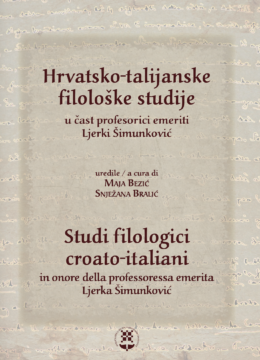
This monography is dedicated to Professor Emerita Ljerka Šimunković, PhD, founder and first Head of the Department of Italian Language and Literature at the Faculty of Humanities and Social Sciences Split, and founder and long-serving President of the Croatian–Italian Cultural Association Dante Alighieri Split. It is the result of the long-standing collaboration between Croatian and Italian scholars, particularly Croatian Italianists, inspired by Professor Šimunković’s academic work and her commitment to fostering scholarly and cultural exchange. The volume aims to contribute new insights and encourage further research into topics in Italian Studies related to the two Adriatic coasts. The book comprises sixteen philological studies by Croatian and Italian scholars, colleagues, and friends of Professor Šimunković, united by their shared interest in the Italian language, literature, and culture. The contributions are grouped into three thematic sections: Italian Literature and Identity, Literature and Culture, and The Italian Language in Synchrony and Diachrony. The first section focuses on questions of identity, cultural belonging, and intertextuality through analyses of works by Italian and Italian-language authors. Particular attention is devoted to representations of identity, alienation in the modern age, and the literary production of Italian-speaking authors outside Italy, including the Split-born polymath Julije Bajamonti and the Swiss writer Grytzko Mascioni. The second section examines a range of historical, literary, and cultural topics, offering new perspectives on the social and cultural contexts of Italian and Croatian literary traditions. The final section addresses linguistic issues from synchronic and diachronic perspectives. The contributions explore bilingualism and linguistic identity among Italian immigrants, the preservation of Romance lexical elements in the maritime and fishing vocabulary of Dalmatian island dialects, and selected aspects of Italian grammar from the perspectives of the history of the Italian language and Italian–Croatian contrastive analysis. Bringing together literary, linguistic, and cultural perspectives, the volume reflects the long-standing Croatian–Italian scholarly cooperation and makes a valuable contribution to contemporary research in Italian Studies and Adriatic cultural and linguistic relations.