
Guidelines for authors
Školski vjesnik: journal of pedagogic theory and practice is an international, peer-reviewed journal open to scientists from the field of pedagogy as well as its partner sciences and disciplines. The journal publishes scientific papers that are original primary publications, that is, papers that have not been previously published.
JOURNAL STRUCTURE
The journal consists of the following segments:
- Contents
- Editorial
- Papers
- Guidelines for Authors.
Texts in the Školski vjesnik journal are published in the Croatian language with the version of the full text in the English language. Texts can also be published in the English language with the version of the abstract in the Croatian language.
PAPER ACCEPTANCE PROCEDURE
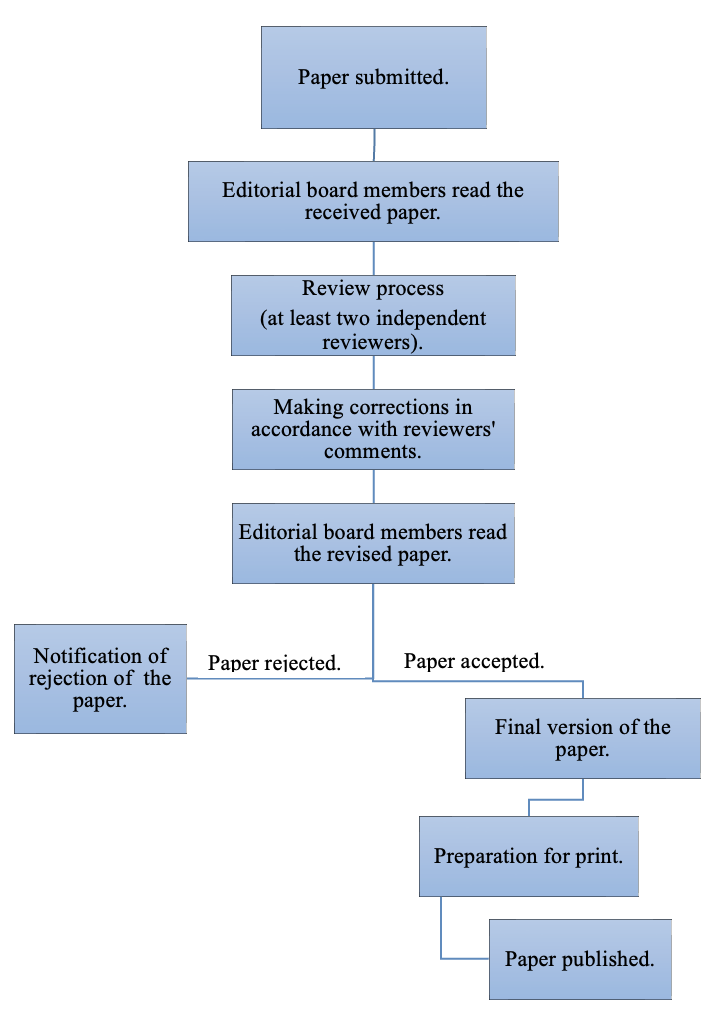
- Members of the editorial board read all the submitted papers according to the date of receipt of the papers and decide on initiating the review process.
- The paper must be previously unpublished, and it cannot be simultaneously under consideration for publication in other journals, as guaranteed by the author.
- The paper is submitted in compliance with Guidelines for Authors following Article Writing Template. In case the paper is not written in compliance with the Guidelines for Authors and according Article Writing Template, the paper will be returned to the author without having been reviewed.
In the review process, the paper is sent to at least two reviewers of whom at least one is an international reviewer. The reviewer returns the reviewed paper to the editorial board. The editorial board forwards the paper along with reviewers’ review to the author for revising or correcting in accordance with reviewers’ comments. In case of a negative review, the paper is not accepted for publication. The paper which was sent to the author for correcting or revising is returned by the author to the editorial board after correcting. Members of the editorial board read the corrected and revised paper and if the paper was correctly revised, the paper is considered for publication according to the categorisation of the paper – original scientific paper, preliminary communication, review article. Publication of the paper is possible if the paper was reviewed positively as a scientific paper by at least two independent reviewers.
The authors, as well as the editors, members of the editorial board and reviewers are expected to adhere to the standards of ethical conduct and comply with the guidelines of the Committee on Publication Ethics (COPE) and the Publishing Ethics of Školski vjesnik. guidelines of the Committee on Publication Ethics (COPE) and the Publishing Ethics of Školski vjesnik.
PUBLICATION DECISION
The decision regarding publication is made by the editorial board, primarily considering the reviewers’ opinion. The editorial board informs the author of the reviewers’ opinion within six months of paper submission. The editorial board is not obligated to explain its decision and the reviewers’ opinion. If the received reviews are contradictory, the editorial board sends the paper to a third reviewer or decides independently on the final category of the paper.
LANGUAGES
Papers in the journal are published in the Croatian language with the version of the full text in the English language. Texts can be also published in the English language with the version of the abstract in the Croatian language. Papers must be proofread. Authors take full responsibility for the quality of the translation of the text. Following acceptance of the paper for publication by the editorial board, authors have to enclose statements certifying that the Croatian and/or English version of the paper have been proofread.
AUTHORS’ RIGHTS
There is no payment for authors’ rights. Upon acceptance of the paper the author signs a statement of authorship of the paper. By submitting the paper to Školski vjesnik, the author agrees without any subsequent conditions to the publication of the complete paper on the web page of Školski vjesnik (http://skolskivjesnik.ffst.unist.hr) that is, of the Faculty of Humanities and Social Sciences in Split (https://www.ffst.unist.hr), and other electronic portals on which the journal is represented. By submitting the paper for publication in Školski vjesnik the author accepts the above-stated conditions.
TEXT PREPARATION AND VISUAL STYLE OF THE PAPER
Authors have to follow Article Writing Template when composing their text. Only papers prepared according to the Guidelines for Authors and the Article Writing Template will be considered for publication in Školski vjesnik.
Format: LibreOffice or Microsoft Word.
Language: Croatian and English.
SUBMITTING THE PAPER: the paper is submitted in the following form: A4 format, margin size 3 cm, font size 11 pt, font type Times New Roman, single line spacing (1.0), exclusively via electronic mail at skolskivjesnik@ffst.hr. It is recommended to use italics instead of underlining. On the first page of the paper, the first name and surname of the authors and the institutions with address in which the authors are employed as well as the authors’ email address should be written above the title in the upper left corner. When submitting the paper, authors should also list personal details of all the authors (their respective first names and surnames, titles, institutions, addresses and email addresses).
LENGTH OF THE PAPER: including the abstract and the bibliography, the paper should not be shorter than 15 pages or longer than 20 pages.
TITLE OF THE PAPER: upper-case letters, centred, Times New Roman, font size 12 pt, bolded.
ABSTRACT: up to 1000 characters, font type Times New Roman, font size 11 pt, written in italics. The abstract should summarize the paper, refer to the main theoretical orientations, state the aim of the paper, the methodology, the main results and the conclusion. The abstract should be placed at the beginning of the paper and labelled Abstract: in bold and italics. Keywords: (three to five words that do not appear in the title of the paper) should be listed alphabetically at the end of the abstract.
TEXT OF THE SCIENTIFIC PAPER: The paper is written in Times New Roman font, with font size 11 pt. and 1.0 line spacing. Subtitles are not numbered and are written in upper-case letters. There is an empty line before and after each subtitle. In the text of the paper, the first line of each paragraph is indented. Automatic settings for spacing which add an empty line before or after each paragraph should not be used.
Text consists of the following parts: Introduction, Method/Methodology, Results and Discussion, Conclusion and References.
The Introduction should describe the topic, express what is being researched and why, present important knowledge about the research problem and present the results of previous research. The authors should state the aim of the research and hypotheses or research questions at the end of the Introduction.
The section Method/Methodology should describe the research sample, the research instrument and the procedure, the analysis of research results, using the past tense. When listing the names of participants in a research that was carried out by the authors, the authors have to enclose a statement certifying that the participants consented to having their names published in the journal and that they consented to take part in the research.
The Results and Discussion are written in the past tense. It is necessary to clearly and precisely present the main results (tabular or graphical), explain the meanings of the results and the relationships that arise from them, compare the results with the results of other researchers and present their theoretical and practical effects.
The Conclusion presents the basic conclusions of the paper, without introducing new elements. An overall overview of the paper is given and the contribution of the paper is given to a better understanding of the research area.
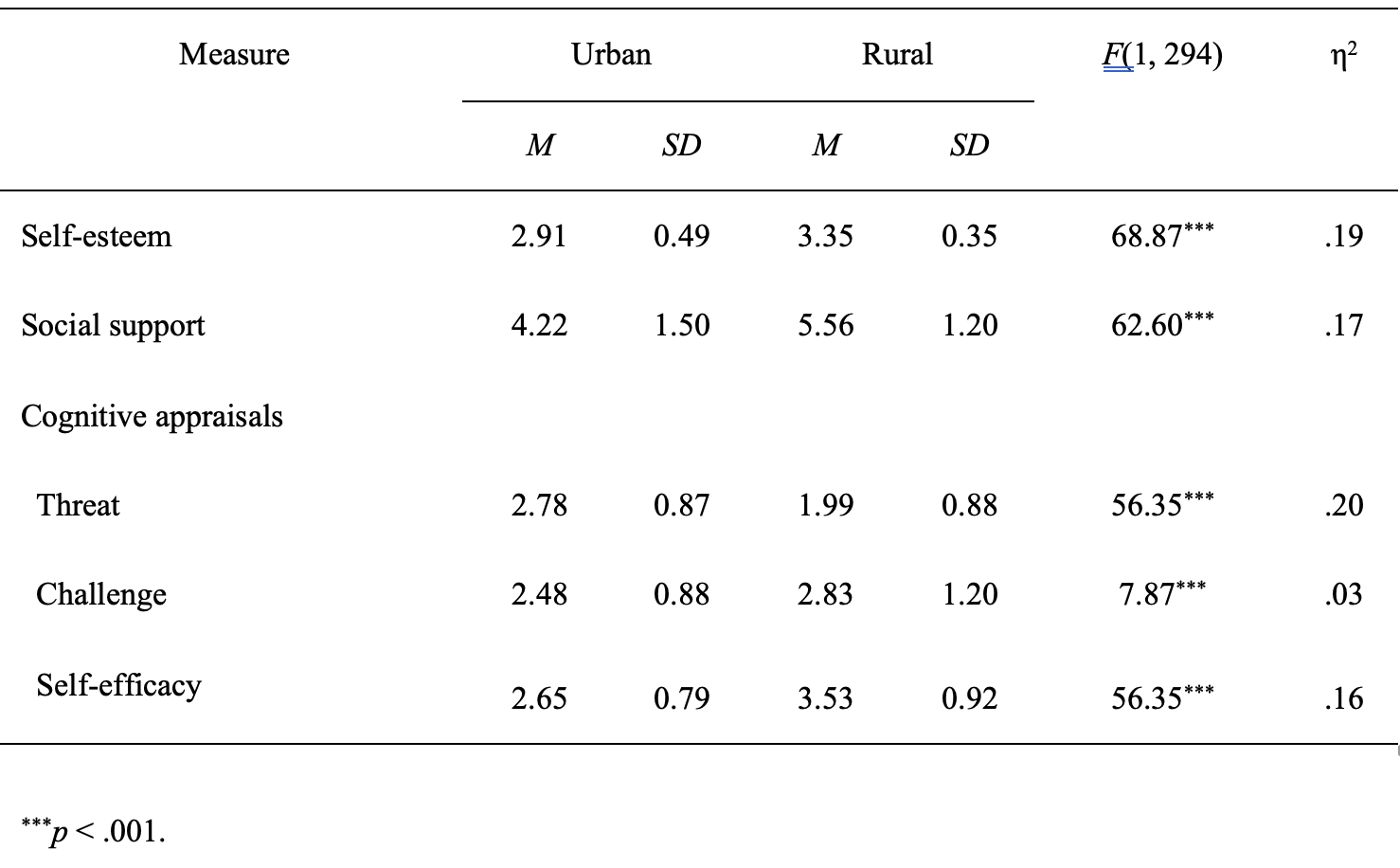
GRAPHICAL FIGURES AND TABLES: Images, tables and graphs should be in black, white and a single tone of grey and they should be positioned in the appropriate place within the text, denoted in Times New Roman font, with font size 10 pt. Each graphical display or table must have a title and a number (Arabic numerals) to use as reference in the text. The table number (e.g. Table 1) is located above the table (Times New Roman, font size 10 pt, left alignment, bold). The table title appears one double-spaced line below the table number (italic title case). The table body may be single-spaced, one-and-a-half-spaced, or double-spaced. Horizontal lines are only used at the top and bottom and to separate major sections of the table. Tables have no vertical lines.
Table 1
Means, Standard Deviations, and One-Way Analyses of Variance in Psychological and Social Resources and Cognitive Appraisals
The figure number (e.g. Figure 1) appears above the figure title and image (Times New Roman, 10 pt, left-align, in bold). The figure title appears one double-spaced line below the figure number (italic title case).
Authors have to enclose a statement certifying that authors’ rights are respected when using images, photographs and other materials for which authors’ rights are protected by the authors’ rights and related rights act entitled, in the Croatian language, Zakon o autorskom pravu i srodnim pravima. Images, photographs, graphs and other materials used in the paper should be clear and visible. The editorial board reserves the right not to publish content that is not in compliance with what was stated above.
CITATIONS AND REFERENCES: Školski vjesnik journal uses the APA style for citations and bibliographic referencing (https://apastyle.apa.org). The reference list should include only the bibliographic entries on the basis of which the paper was written. If the thoughts, sentences or syntagms of others are cited in the paper, the source should be stated in the text (e.g. Gudjons, 1994, pp. 34), and not in the footnotes or at the end of the paper. Authors in parentheses should be listed alphabetically. In addition to the first appearance of the abbreviation, it is necessary to state the full name (e.g. Ministry of Science and Education, MSE). The list of references should include, in alphabetical order by author surname, all the papers that are cited or referred to in the text. The DOI should be listed for all sources that have it, and a valid URL should be provided for those that do not have it.
References
Notice that the entries in the reference list have a hanging indent (CTRL+T).
EXAMPLES:
a) Book
Slunjski, E. (2018). Izvan okvira 3 – Vođenje: Prema kulturi promjene. Element.
Hacker, Huges, J. (Ed.) (2017). Military veteran psychological health and social care: Contemporary approaches. Routledge.
Miller, A. J., Thomson, F., & Callagher, D. (1998). Affluence in suburbia. BL Books
Brown, L. S. (2018). Feminist therapy (2nd ed.). American Psychological Association. https://doi.org/10.1 037/0000092-000
Schmid, H.-J. (Ed.). (2017). Entrenchment and the psychology of language learning: How we reorganize and adapt linguistic knowledge. American Psychological Association; De Gruyter Mouton. https://doi.org/10.1037/15969-000
Piaget, J., & Inhelder, B. (1966). La psychologie de I’enfant [The psychology of the child]. Ouadrige.
b) Chapter in an edited book
Matijević, M. (2017). Neke prednosti i epistemološke vrijednosti studija slučaja u pedagogijskim istraživanjima. In S. Opić, B. Bognar, & S. Ratković (Eds.), Novi pristupi metodologiji istraživanja odgoja (pp. 109–128). Učiteljski fakultet u Zagrebu.
Weinstock, R., Leong, G. B., & Sylvia, J. A. (2003). Defining forensic psychiatry: Roles and responsibilities. In R. Rosner (Ed.), Principles and practice of forensic psychiatry (2nd ed., pp.7–13). CRC Press.
Balsam, K. F., Martell, C. R., Jones, K. P., & Safren, S. A. (2019). Affirmative cognitive behavior therapy with sexual and gender minority people. In G. Y. Iwamasa & P. A. Hays (Eds.), Culturally responsive cognitive behavior therapy: Practice and supervision (2nd ed., pp. 287–314). American Psychological Association. https://doi.org/10.1037/0000119-012
c) Journal article
Visković, I., & Ljubetić, M. (2019). The expert opinion on quality of family functioning in Croatia. International journal of cognitive research in science, engineering and education, 7(3), 1–11. https://doi.org/10.5937/IJCRSEE1903001V
McCauley, S. M., & Christiansen, M. H. (2019). Language learning as language use: A cross-linguistic model of child language development. Psychological Review, 126(1), 1–51. https://doi.org/10.1 037/ rev0000126
Chaves-Morillo, V., Gómez Calero, C., Fernández-Muñoz, J. J., Toledano-Muñoz, A., Fernández-Huete, J., Martínez-Monge, N., Palacios-Ceña, D., & Peñacoba-Puente, C. (2018). La anosmia neurosensorial: Relación entre subtipo, tiempo de reconocimiento y edad [Sensorineural anosmia: Relationship between subtype, recognition time, and age]. Clínica y Salud, 28(3), 155–161. https://doi.org/10.1016/j.clysa.2017.04.002
d) Conference proceedings
Car Mohač, D. (2018). Odgojitelj – istraživač odgojne prakse. In S. Tomaš, I. Blažević & I. Restović (Eds.), 11. dani osnovnih škola Splitsko-dalmatinske županije – Od znanosti do učionice (pp. 27–35). Filozofski fakultet Sveučilišta u Splitu.
e) Dissertations and Theses
Mandarić Vukušić, A. (2016). Roditeljska kompetencija i (ne)pedagoška zanimanja [Doctoral dissertation, University of Zagreb]. Repozitorij Filozofskog fakulteta u Zagrebu. http://darhiv.ffzg.unizg.hr/id/eprint/6917/1/Mandaric-doktorat.pdf
Hollander, M. M. (2017). Resistance to authority: Methodological innovations and new lessons from the Milgram Experiment (Publication No. 10289373) [Doctoral dissertation, University of Wisconsin-Madison]. ProQuest Dissertations and Theses Global.
f) Internet source
Ministarstvo znanosti i obrazovanja (2020). Obrazovanje odraslih. Republika Hrvatska, Ministarstvo znanosti i obrazovanja
2020). Programi obrazovanja odraslih. Repubika Hrvatsak, Ministarstvo . https://mzo.gov.hr/istaknute-teme/odgoj-i-obrazovanje/obrazovanje-odraslih/131
World Health Organization. (2018, March). Questions and answers on immunization and vaccine safety. https://www.who.int/features/qa/84/en
g) Tests and inventories
Tellegen, A., & Ben-Porath, Y. S. (2011). Minnesota Multiphasic Personality Inventory-2 Restructured Form (MMPI-2-RF): Technical manual. Pearson.
Alonso-Tapia, J., Nieto, C, Merino-Tejedor, E., Huertas, J. A., & Ruiz, M. (2018). Situated Goals Questionnaire for University Students (SGO-U, CMS-U) [Database record]. PsycTESTS. https://doi.org/l 0.1 037/t6626 7 -000
h) Regulations, official documents
Australian Government Productivity Commission & New Zealand Productivity Commission. (2012). Strengthening trans-Tasman economic relations. https://www.pe.gov.au/inquiries/completed/australia-new-zealand/reportltrans-tasman.pdf
ETHICAL GUIDELINES AND CODE OF CONDUCT
Školski vjesnik adheres to the principles of publishing ethics and the guidelines of the Committee on Publication Ethics (COPE). Authors, editors, members of the Editorial Board, and reviewers are expected to uphold the principles of academic integrity, professional responsibility, and good publishing practice.
Responsibilities of Authors
Authors guarantee that the submitted manuscript is original, has not been previously published, and is not simultaneously under consideration for publication in another journal. All sources used must be properly acknowledged and cited in accordance with APA referencing style.
Any form of plagiarism, self-plagiarism, data manipulation, falsification of results, or other forms of unethical conduct constitutes grounds for rejection or retraction of the manuscript.
Authors are required to disclose any potential conflict of interest that could influence the research results, interpretation of data, or the publication process.
Research involving human participants must be conducted in accordance with applicable ethical standards and the regulations of the authors’ home institutions. Authors are encouraged to provide information on the approval of the relevant ethics committee where applicable.
Responsibilities of the Editorial Board and Reviewers
The Editorial Board ensures an impartial, objective, and confidential peer-review process. Reviewers are expected to evaluate manuscripts professionally, objectively, and without personal or professional bias.
All participants in the editorial and review process are required to disclose any potential conflict of interest. In cases of conflict of interest, the Editorial Board may exclude a reviewer or Editorial Board member from the decision-making process regarding the manuscript.
Retraction and Corrections
The Editorial Board reserves the right to retract a published manuscript in cases of confirmed plagiarism, serious methodological errors, data manipulation, or other forms of unethical conduct.
If minor errors that do not affect the scientific credibility of the manuscript are identified after publication, the journal may publish a correction, amendment, or clarification.
Use of Artificial Intelligence Tools
Authors bear full responsibility for the content of the manuscript, including any parts created with the assistance of artificial intelligence tools. Authors are encouraged to transparently disclose the use of such tools if they were employed in writing, language editing, or data analysis.
LICENSE AND TERMS OF USE
Articles published in Školski vjesnik are available in open access and may be used, shared, and cited provided that the author and source are properly acknowledged.
Authors retain copyright of their work, and by submitting a manuscript they consent to its publication in print and electronic form, as well as on the journal’s website and other relevant databases and portals.
Articles published in Školski vjesnik are distributed under the Creative Commons Opne Access 4.0 (CC BY 4.0).
The license permits the use, sharing, reproduction, and adaptation of the content in any medium or format, provided that appropriate credit is given to the original author and source of publication.
PUBLICATION: the journal is published biannually in printed and electronic version.
Rights (CC BY 4.0 open access licence). The complete text of the articles published in the journal may be used without compensation, under the terms of the author and publisher copyright rights.

